A new trio: ATLAS finds first evidence of ZZy production
13 May 2026 | By
The ATLAS Collaboration reports the first evidence of the simultaneous production of a photon and two neutral Z bosons at the LHC.
The electroweak sector of the Standard Model combines the weak interaction, mediated by charged W bosons and the neutral Z boson, with electromagnetism, carried by the photon (γ). It governs a vast amount of physics processes, from particle decays to the radiative output of the Sun. In the 1990s, physicists measured the properties of the W and Z bosons with remarkable precision using data from CERN’s Large Electron–Positron (LEP) collider. Studying the simultaneous production of three of these force-carrying particles, however, would have to wait for the higher collision energies of the Large Hadron Collider (LHC).
Multi-boson processes are among the most sensitive tests of the Standard Model. Theoretical predictions for these interactions are extremely precise, so even small discrepancies could point to new physics phenomena. Triboson processes are the rarest of this kind, offering unique sensitivity to probe quartic boson couplings and complementarity with Higgs physics and searches beyond the Standard Model. The ATLAS Collaboration has explored such processes in collision events with three W bosons (WWW), a W or Z boson in combination with two photons (Wγγ, Zγγ), two W or Z bosons together with a Z boson (VVZ), two W bosons with a photon (WWγ), and a W boson, Z boson and a photon (WZγ).
In a new publication, ATLAS physicists report the simultaneous production of two Z bosons together with a photon (ZZγ) for the first time at the LHC. With a statistical significance of 4.4 standard deviations, the study extends the LHC’s repertoire of multi-boson studies and provides a complementary test to those already observed.
In a new publication, ATLAS physicists report the simultaneous production of two Z bosons together with a photon (ZZγ) for the first time at the LHC.

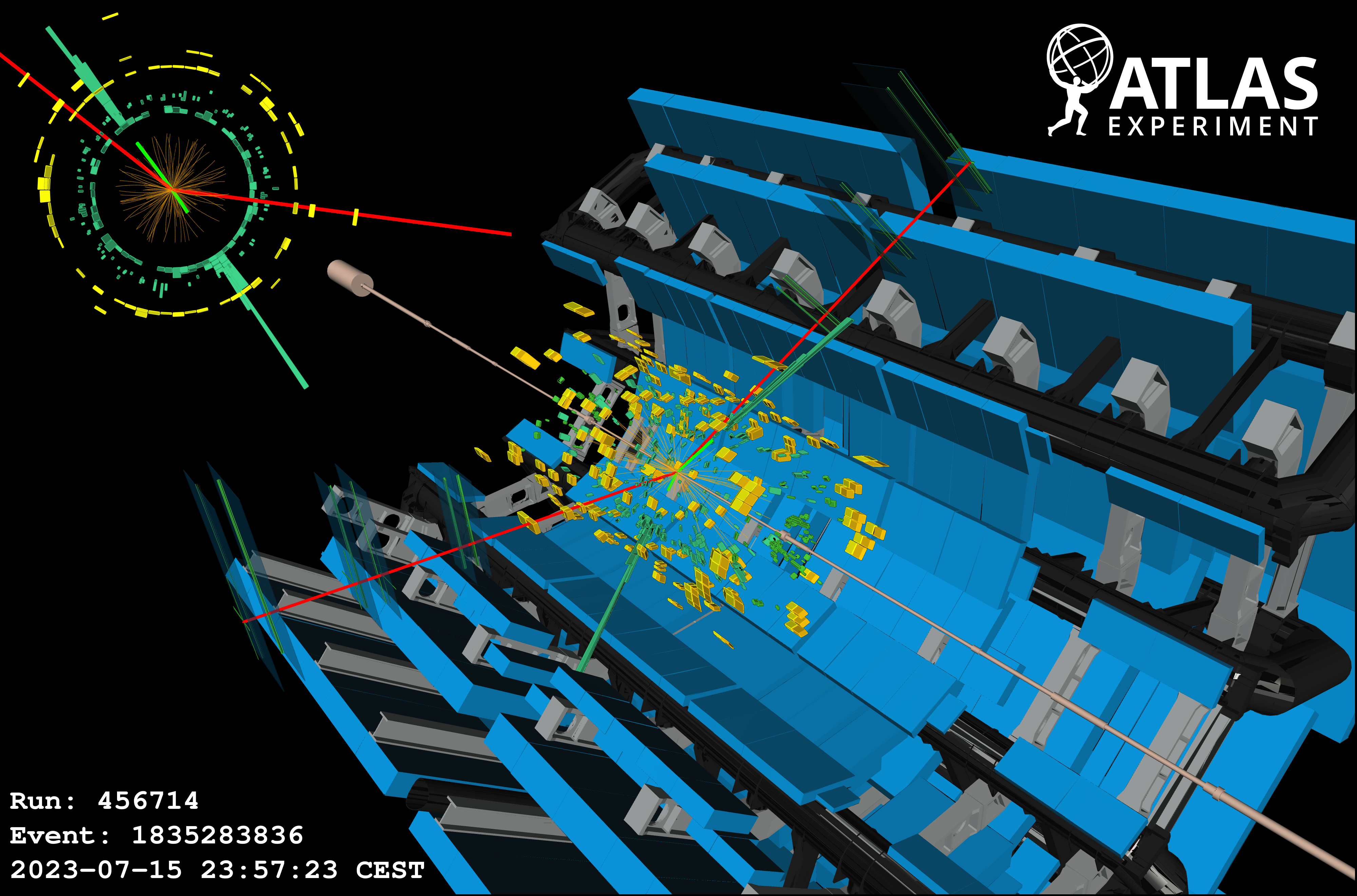
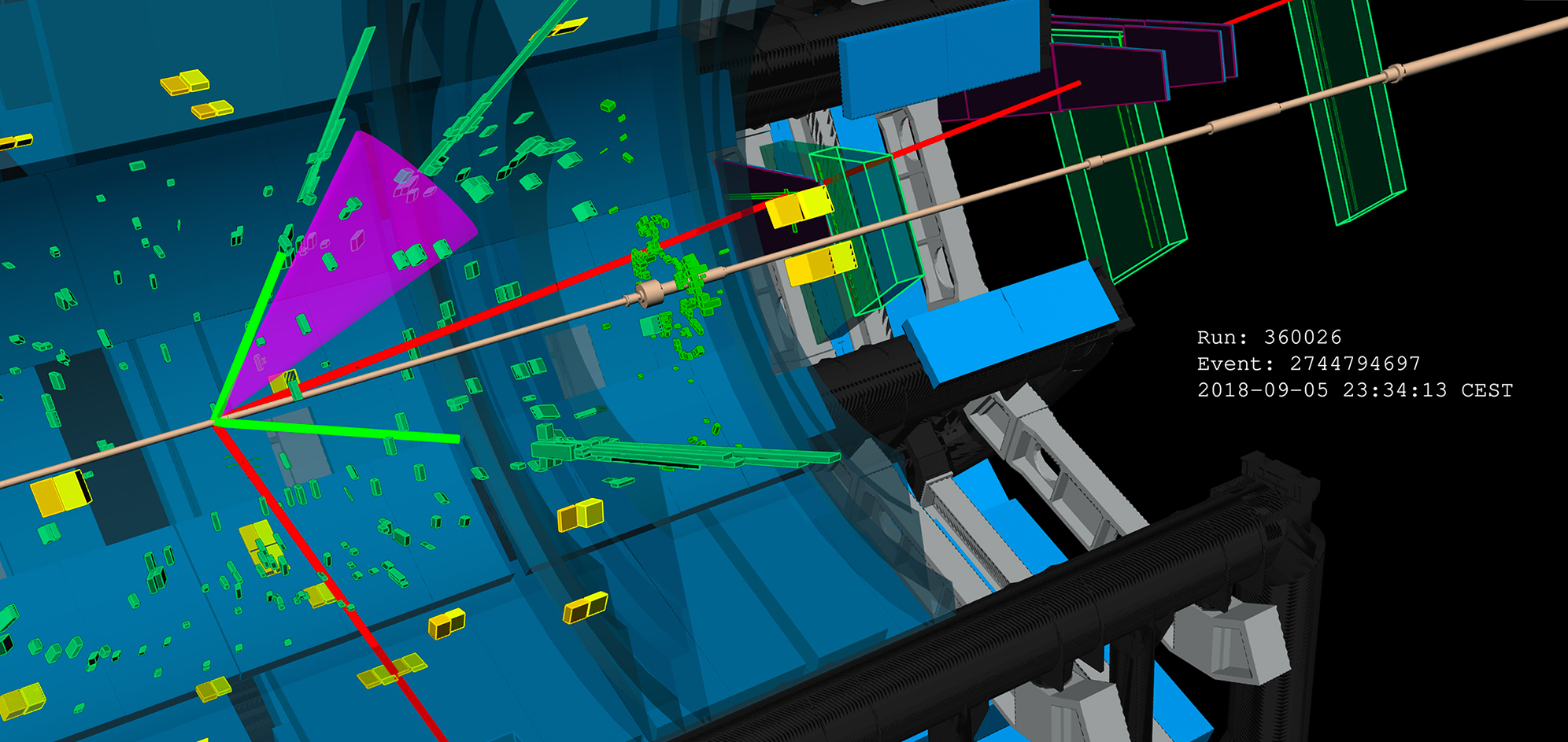
The analysis uses the full LHC Run-2 dataset (collected between 2015 and 2018) of proton-proton collisions. Physicists focused on collision events where two Z bosons each decay into pairs of electrons or muons, accompanied by a photon of sizable energy. They applied a dedicated selection to exclude events in which the photon originates from the electrons or muons themselves. Each selected event therefore contains four charged particles (4e, 2e2μ, or 4μ) and one photon – an extremely rare combination. Theory predicts only seven signal events in the entire Run-2 dataset and only about one background event, arising mainly from “jets” of particles being misidentified as photons.
To avoid any bias, the analysis was carried out “blinded”, i.e. event selection and background studies were performed using simulated events as well as control samples. After these cross checks were completed, the data were unblinded and eight events met all the required selection criteria – a result spot on with the theoretical prediction.
Figure 1 shows the number of expected and observed events for the three different decay channels of the Z-boson pair (4e, 2e2μ, or 4μ) and for their combination (4ℓ). The expectation includes the theoretical prediction for the signal as well as estimated background contributions. The results agree with expectations for the three event classes separately and for the full sample.
The result has a statistical significance of 4.4 sigma, meaning the probability that the eight events are a random fluctuation from background-only processes is roughly one in ten thousand. This is strong evidence, though still below the five-sigma threshold required to claim a discovery. Studies of the LHC Run-3 dataset (2022–2026) and the future High-Luminosity LHC dataset will allow a discovery of this process and enable even more detailed tests of the electroweak sector.
Learn more
- Evidence of ZZy production with the ATLAS detector (arXiv:2602.17165, see figures)
- SM@LHC presentation by Anke Ackermann: Measurement of ZZγ production with the ATLAS detector
- Shining light on the Weak force: ATLAS observes WWγ production, Physics Briefing, October 2025
- Massive vector bosons also come in triplets, Physics Briefing, January 2025
- Three’s no crowd: ATLAS measures tri-boson production, Physics Briefing, August 2023