
Catching the vacuum in the act with the ATLAS Experiment
27 November 2026 | By
Why is there anything here at all? If the Big Bang produced matter and antimatter in equal amounts – as scientists predict – the two should have annihilated one another, leaving behind a universe filled with little more than light. Yet here we are.
For matter to have won out, two things must be possible. First, Nature must treat matter and antimatter differently, as experiments such as LHCb or Belle are studying in detail. Second, it must allow the total amount of matter to change – something ordinary particle interactions cannot do.
The Standard Model, however, does provide a way for this to happen: through transitions between different configurations of the electroweak field. These are possible because empty space is not as empty as it looks. The vacuum comes in an infinite number of varieties, each with the force field twisted up a different number of times. Every so often, the vacuum can “quantum tunnel” from one variety to another. In 1976, Nobel Prize-winning theorist Gerard ’t Hooft showed that, for the weak force, such transitions can create or destroy matter. In the heat of the early universe, these transitions would have been common, taking place in phenomena called sphalerons.
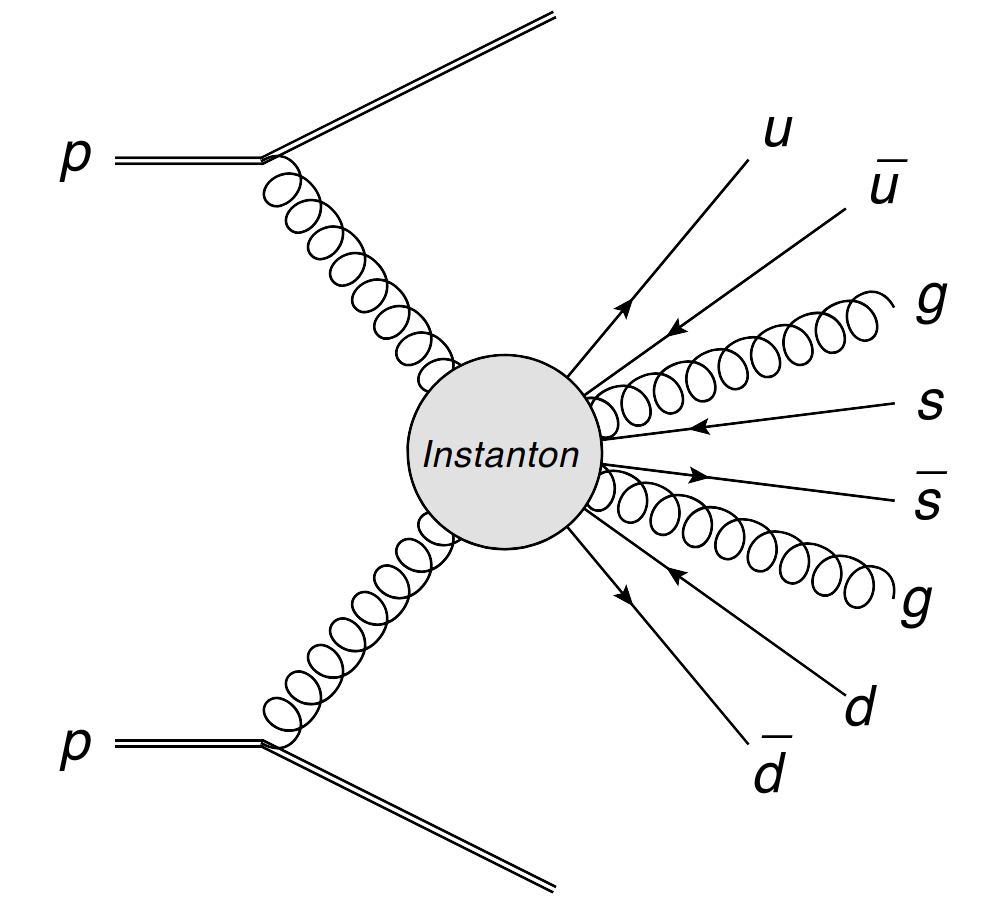
The strong force, described by quantum chromodynamics or QCD, has its own version of these transitions. QCD instanton processes occur when tunnelling through the energy barrier between QCD field configurations (Figure 1). These transitions do not create matter, but they do break another rule: they can flip the “handedness” of quarks. This is a fascinating example of new physics hiding in the Standard Model. And while it remains uncertain whether electroweak sphalerons can be produced at the LHC, QCD instantons should be within reach, offering a rare chance to test the topological side of Nature in a laboratory.
The ATLAS Collaboration has just released the first search for QCD instantons at the LHC, finding an intriguing excess of events that bear several hallmarks expected from instanton processes.This may be the first experimental hint of vacuum tunnelling, arriving half a century after ’t Hooft's seminal work.
Fifty years after Gerard ’t Hooft’s work, ATLAS may have caught a first glimpse of vacuum tunnelling.
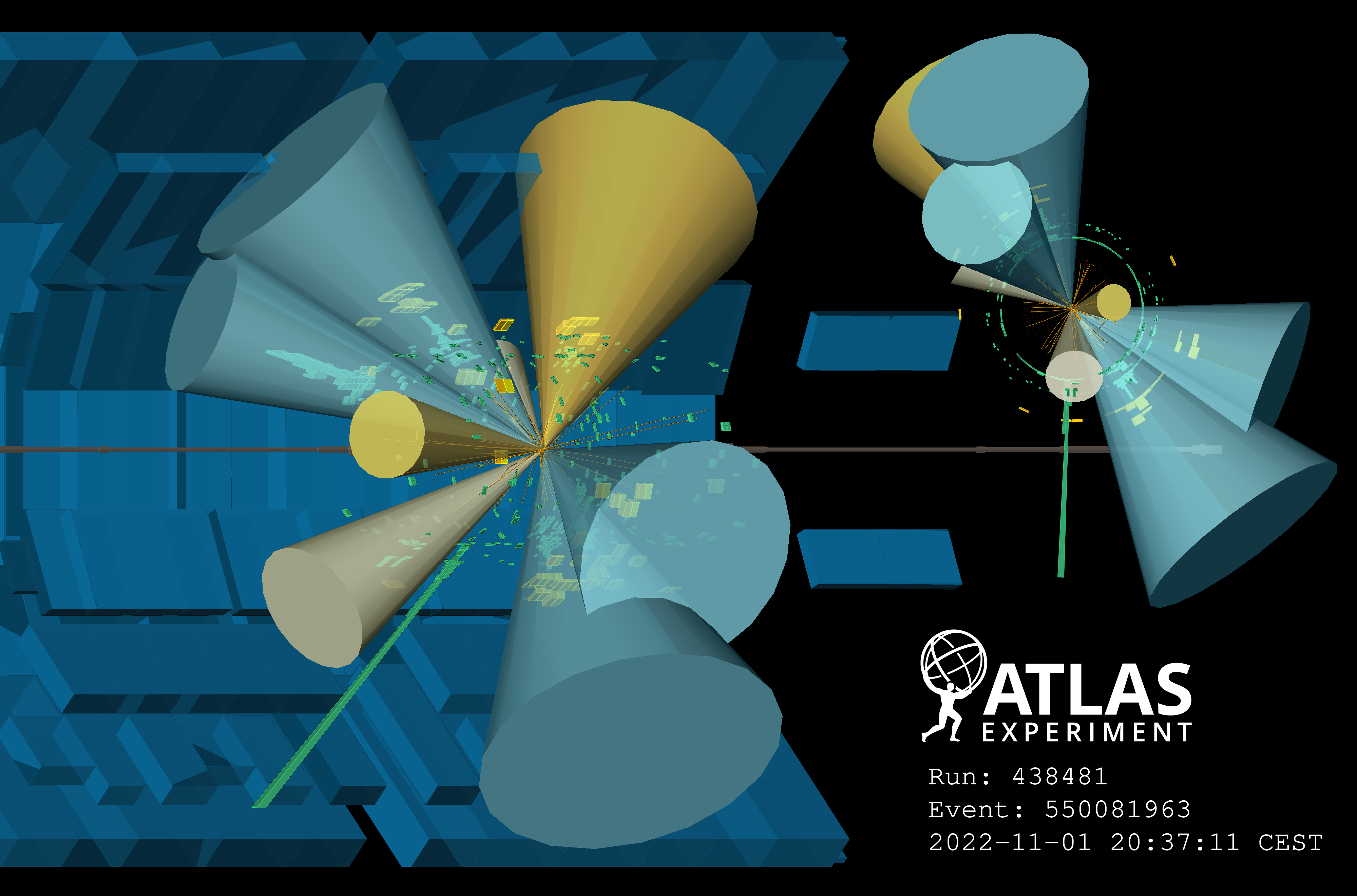
Instantons are incredibly hard to spot. They are expected to burst into many low-energy particles flying out in all directions, creating a sort of spherical “firework” (see banner image). However, ordinary proton–proton collisions can produce a very similar spray of particles, making instanton processes difficult to distinguish.
To overcome this challenge, ATLAS physicists studied a special dataset recorded in 2015, when the LHC was operating with very few simultaneous collisions. This less crowded environment gave them a clearer view of each collision. Under these conditions, the main background came from low-energy interactions between protons, which are difficult to predict accurately with theoretical models. Researchers trained neural networks to recognise the tell-tale spherical shape of instanton events and estimate the background directly from the data themselves.
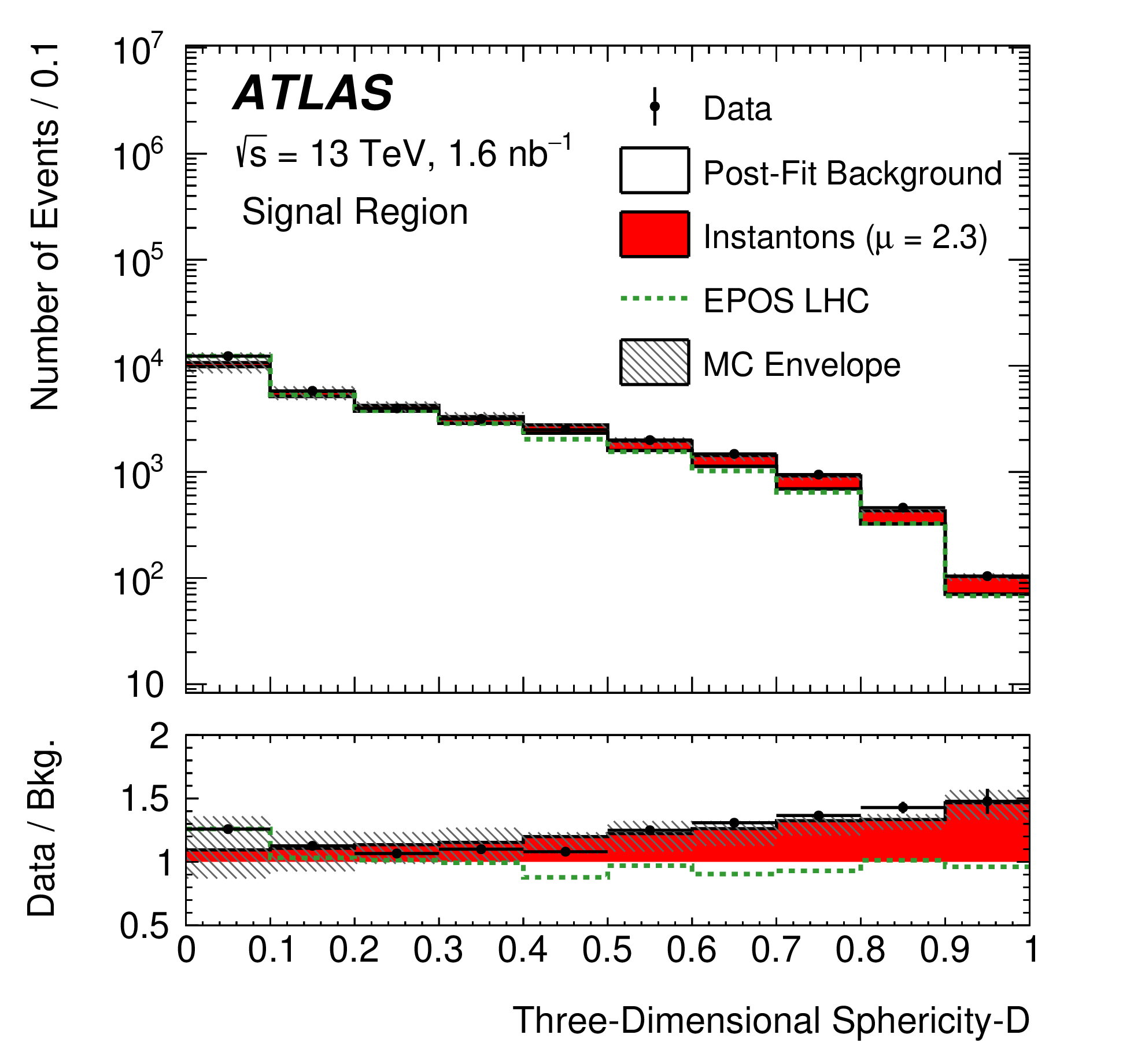
The ATLAS team found more of these spherical, particle-rich events than predicted by the best available models describing ordinary collisions (Figure 2). The pattern of this excess is consistent with the production of instantons and had an observed significance of 3.5 standard deviations relative to the background-only model. In the region most sensitive to instantons, the ATLAS Collaboration observed 32,789 events, where 28,800 are attributed to ordinary collisions and about 3900 to a possible instanton signal. The fitted signal rate was 2.3 ± 0.6 times the benchmark prediction, with the uncertainty reflecting experimental effects only. The predicted rate has its own uncertainty that spans orders of magnitude, so more precise theory calculations are needed to interpret that comparison
An excess is not yet a discovery. More data, better models of ordinary collisions and new techniques could reveal whether instantons are really responsible for this excess. If they are, it would confirm that the vacuum really can change, undergoing the same topological physics that may explain why there is any matter in the universe at all.
Learn more
- Search for the low-mass isotropic signature of QCD instantons in pp collisions using the ATLAS detector (arXiv:2611.22092, see figures)
- G. ’t Hooft, Symmetry Breaking Through Bell-Jackiw Anomalies (Phys. Rev. Lett. 37 (1976) 8)
- V. V. Khoze, F. Krauss, M. Schott, Large Effects From Small QCD Instantons: Making Soft Bombs at Hadron Colliders (JHEP 04 (2020) 201)
- H1 Collaboration: Search for QCD instanton-induced processes at HERA in the high-Q² domain
- LHCC Open Session presentation by Yohei Yamaguchi: ATLAS Status Report